Your Complete Guide to Handling a Car Accident in Hawaiʻi: From Scene to Claim
Reading Time: 5-6 Minutes

Key Takeaways
Prioritize safety first, then document everything with photos and information exchange.
Hawaiʻi's no-fault system means your PIP coverage pays your medical expenses regardless of fault.
Never admit fault at the scene; let professionals determine responsibility.
Report accidents to your insurance company promptly, even for minor fender benders.
Car accidents happen when you least expect them: during your daily commute, while running errands, or on an otherwise ordinary day. One moment you're driving normally, and the next, you're dealing with an unexpected collision that changes everything in an instant.
What you do in the minutes following an accident can significantly affect your safety, legal standing, and insurance coverage. This guide walks you through essential information about Hawaiʻi's requirements and best practices to help you respond appropriately after a car accident.
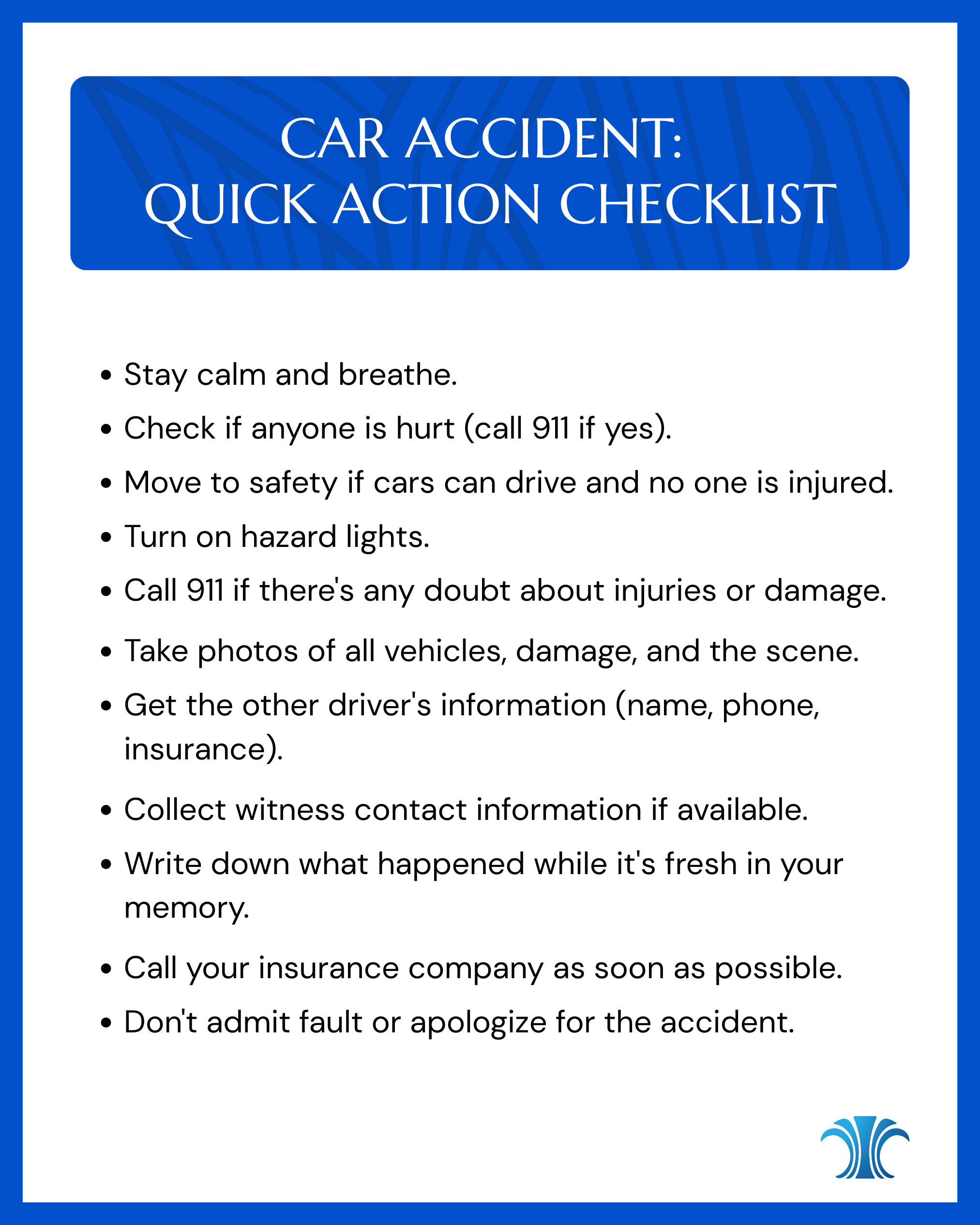
Quick Action Checklist
If you just got in an accident, follow these steps:
Stay calm and breathe
Check if anyone is hurt (call 911 if yes)
Move to safety if cars can drive and no one is injured
Turn on hazard lights
Call 911 if there's any doubt about injuries or damage
Take photos of all vehicles, damage, and the scene
Get the other driver's information (name, phone, insurance)
Collect witness contact information if available
Write down what happened while it's fresh in your memory
Call your insurance company as soon as possible
Don't admit fault or apologize for the accident
Read the full guide below for detailed explanations of each step.
Safety First
Check yourself and your passengers carefully. Move your arms and neck slowly, then check everyone in the vehicle. Ask specific questions like "Does anything hurt?" or "Can you move everything normally?" That stiff neck that feels minor now could turn into serious whiplash within hours.
If everyone seems uninjured and your vehicle can be driven, move out of traffic right away. If your vehicle cannot be moved safely, or even if you’re able to pull onto the shoulder of the road, turn on your hazard lights immediately.
When in doubt, call 911. If anyone reports pain, if you see major vehicle damage, if the other driver appears impaired or acts strangely, or if you have any doubt at all, call. That police report becomes important evidence when insurance companies review your claim and determine who was at fault.
Document Everything Now
Take photos and capture the scene from every angle. Wide shots show the full picture, and close-ups show damage details insurance adjusters need. Capture street signs, landmarks, and traffic signals to show the exact location and conditions.
Exchange information with the other driver: full name, phone number, insurance company, and policy number. If witnesses saw the collision, get their contact information as well. What they saw can be very important in disputed cases.
Write down what happened right away, while details are still fresh. Document the time, weather conditions, road conditions, and what each vehicle did before impact. Keep your descriptions factual and objective.
Hawaiʻi's Insurance Laws Work Differently
Hawaiʻi follows a no-fault system. Each driver pays for their own medical expenses and those of their passengers through Personal Injury Protection (PIP) coverage, no matter who caused the accident.[1]
Your PIP coverage pays for medical bills without waiting for fault decisions. To learn more about PIP, read our article here [insert article].
Filing Your Claim
Call your insurance company as soon as possible after the accident.
Have this information ready:
Your policy number
Accident date, time, and location
A simple description: "I was rear-ended while stopped at a traffic light"
The other driver's insurance information
Police report number (if available)
Understand your deductible: Collision and comprehensive claims usually require paying your deductible before receiving payment. If the other driver is at fault and their insurance accepts responsibility, you may get it back, but this can take time.
Timeline expectations vary widely. Clear-cut rear-end collisions might resolve in a few weeks. Complex cases with injuries or disputed fault can stretch for months or even years. Your insurer should update you regularly, but don't hesitate to reach out if you have questions.
Common Mistakes That Jeopardize Your Claim
Don't admit fault. Even if you think you caused the accident, let professionals determine responsibility. Accidents are often more complex than when they first appear.
Report everything promptly. Insurance policies require quick accident notification. That minor fender bender might lead to injury claims weeks later. Reporting protects you.
Read settlement offers carefully. Releases are usually final. You can't ask for more money if problems show up later. If your damages or injuries are serious, you may want to consult with an attorney.
Watch for delayed symptoms. Whiplash, concussions, and soft tissue injuries often don't hurt right away. Keep your claim open if any discomfort develops. Any pain or stiffness after an accident may need medical attention.
Be Prepared Before Accidents Happen
Save this guide on your phone or keep it in your glove compartment. Review your coverage with your independent insurance agent to make sure it meets your needs.
Review your coverage with your independent insurance agent to make sure it meets your needs. A quick policy review might reveal gaps where additional protection could help. Take a screenshot of the quick guide below and save it in your phone for easy reference.
Disclaimer: This article provides general educational information only and should not be considered professional advice or a recommendation for specific coverage. Insurance needs vary based on individual circumstances. Readers should consult with qualified insurance professionals for personalized guidance. This content does not constitute an offer to sell insurance or guarantee coverage availability.
Frequently Asked Questions
Q: What should I do immediately after a car accident?
A: Check for injuries, move to safety if possible, turn on hazard lights, call 911 if needed, and take photos of all vehicles and damage.
Q: Should I call the police after a minor accident with no injuries?
A: Yes, when in doubt call 911 because the police report becomes important evidence for insurance claims and fault determination.
Q: How does Hawaiʻi's no-fault insurance system work?
A: Each driver's Personal Injury Protection (PIP) coverage pays for their own medical expenses and those of their passengers, regardless of who caused the accident.
Q: Why shouldn't I admit fault at the accident scene?
A: Accidents are often more complex than they first appear, so you should let insurance professionals and investigators determine responsibility.
Q: When should I report an accident to my insurance company?
A: Call your insurance company as soon as possible after the accident, even for minor fender benders, because policies require prompt notification and injuries can appear later.
Sources:
Hawaii Department of Commerce and Consumer Affairs - Motor Vehicle Insurance Information. https://cca.hawaii.gov/ins/consumers/mvi/
Hawaii Revised Statutes - Civil Remedies and Defenses. https://www.capitol.hawaii.gov/hrscurrent/vol13_ch0601-0676/hrs0657/


Related Articles